AVK Southern Africa introduces the Series 869 Control Valve - PN10 & PN16
Saving water saves lives. Water is increasingly becoming a threatened resource that must be protected. Water needs to be conserved for the future generation and growing population must be taken into consideration.
Control valves selection and recommendations
Control valves can help reduce water loss through leakages and contribute to efficient water supply management by maintaining a certain pressure, flow, or level, regardless of changes in the supply network.
Main Features - AVK control valves
Selecting the correct valve in both diameter and type will allow water utilities to manage their networks more efficiently during any 24 hour period, and it is here that the valve manufacturer’s knowledge of how best to use his own product really pays dividends.
In order to select the right product for your application it is recommended to have the following information available:
- Working conditions
- Maximum flow
- Minimum flow
- Continuous flow
- Maximum inlet pressure
- Minimum inlet pressure
- Wanted outlet pressure
- Lifted seat to prevent damage caused by cavitation inside the valve body
- Pipe size
Strainers and Isolating Valves
To filter out impurities that could damage the control valve it is highly recommended to install a protection strainer on the inlet side. Additionally, isolating valves located either side of the control valve enable ease of commissioning and maintenance.
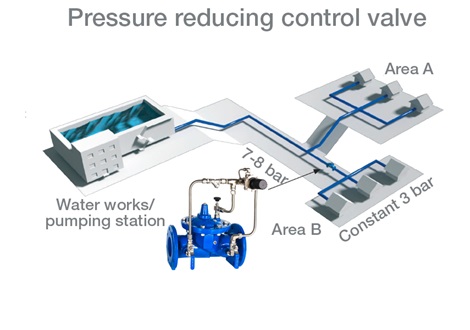
What is a pressure reducing control valve and how does it work?
A pressure reducing control valve automatically reduces a higher inlet pressure to a lower outlet pressure regardless of changes in flow rate or inlet pressure.
The pressure reducing pilot senses the outlet pressure through the connection on the valve outlet port. Under flowing conditions, the pressure reducing pilot reacts to small changes in the outlet pressure, controlling the valve position by modulating the pressure in the control chamber. When the outlet pressure changes according to the set-value of the pilot, the pilot modulates to ensure pressure control.
Example: The pressure is 7-8 bar, which is appropriate to supply the consumers in area A but too high for the consumers in area B. Therefore, a pressure reducing control valve is installed to reduce the pressure to 3 bar in area B.
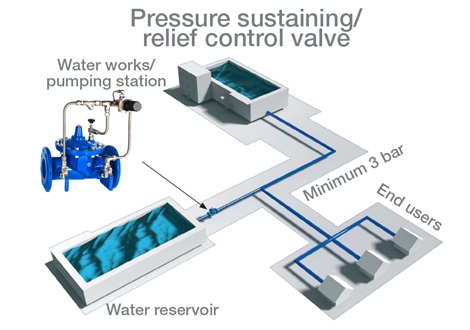
What is a pressure sustaining/relief control valve and how does it work?
A pressure sustaining control valve automatically maintains a minimum preset inlet pressure by relieving excess pressure, regardless of changes in flow rate.
The pressure sustaining pilot reacts to small changes in the inlet pressure, controlling the valve position. If the inlet pressure falls below the set point, the main valve closes or modulates to ensure a minimum inlet pressure. The sustaining valve holds a minimum back pressure on the inlet and normally allows flow. The relief valve normally remains closed and only opens when pressure exceeds a pre-determined set-point.
Example: When the water reservoir fills, the pressure drops, leaving the consumers without water. Therefore, a pressure sustaining control valve is installed to maintain the pressure for the consumers.