Advantages of pressure management in the supply network
Efficient control and regulation of pressure in the water supply network can provide significant resource savings as well as reduce non-revenue water levels.
Pressure management is considered the most beneficial and cost-effective leakage management activity. Pipe bursts occur not only because of high pressure but also due to frequent pressure fluctuations. This forces the pipes to repeatedly expand and contract, resulting in pipe stress and fractures. Moreover, there is a direct correlation between leakage flow rate and pressure – higher pressure leads to higher leakage rate and vice versa. For this reason, the pressure should be kept at a minimum level, ensuring consumer needs are met and not overburdening the network.
Ensuring adequate water pressure for consumers
Water utilities measure the quality of their water supply by their ability to deliver sufficient pressure to consumers. To always guarantee this, the utilities are often using a constant inlet pressure to individual zones or districts.
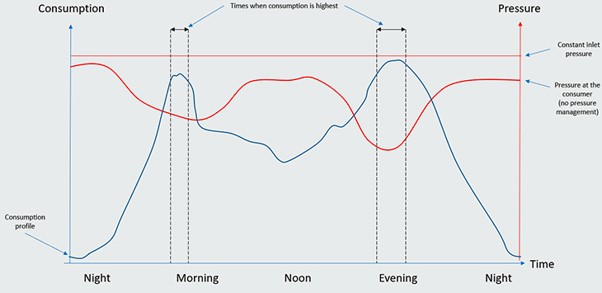
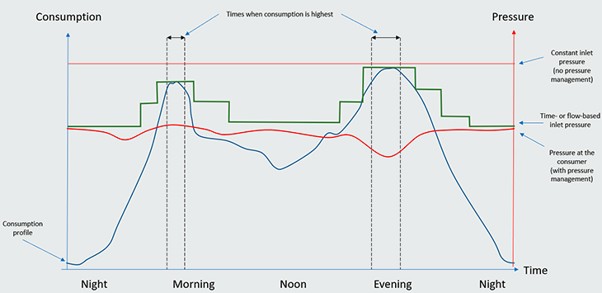
The pressure consumers experience depends on the friction in the supply line. Flow rates are influenced by friction and therefore fluctuates based on consumption. To compensate for the friction, utilities tend to set the inlet pressure higher than the required minimum. However, this constant inlet pressure causes the pressure at the consumer’s end to vary throughout the day – being highest when water demand is low and lowest during peak consumption periods, such as mornings and evenings.
22 Hours of Unnecessarily High Pressure?
To ensure that consumers never experience poor pressure, the inlet pressure is usually set to handle peak consumption periods. However, typical daily consumption patterns show that demand peaks for only a short time during the day usually for no more than two hours total (typically early mornings and early evenings). There are, of course, exceptions to this, such as areas with high water-consuming industries.
This traditional approach results in unnecessarily high pressure for the remaining 22 hours a day, which severely impacts the distribution network. This prolonged high pressure accelerates the wear and tear on network components, shortens asset lifespans, and drastically increases the frequency of pipe bursts and leaks.
Reducing Pressure Directly Correlates with Fewer Pipe Bursts and Lower Leakage
Lowering network pressure directly reduces both pipe bursts and background leakage thereby cutting down non-revenue water loss. An international study highlighted that a 37% reduction in average network pressure led to a 51% decrease in the number of pipe bursts.
High pressure heavily accelerates water loss through existing leaks, as the flow rate from holes in a pipeline is highly dependent on system pressure.
The Cost of a Single Leak: A small 5 mm hole in a pipeline will result in a staggering water loss of approximately 11,520 m³ per year if the network pressure is maintained at 5 bar.
By reducing that pressure to 4 bar, water loss drops by about 11%, saving 1,267 m³ annually from just that one hole. This reduction also translates directly into significant energy savings equivalent to approximately 461 kWh/year per 5 mm hole due to reduced pumping requirements. (See the detailed calculations in the technical box at the bottom of the page).
Time and Flow-Based Approaches to Efficient Pressure Management
Pressure reduction in the distribution network is a highly practical strategy that optimizes system performance without compromising consumer service quality. Lowering the inlet pressure during low-consumption periods maintains an acceptable minimum pressure for consumers while minimizing pipe bursts and fractures. This results in fewer supply interruptions, fewer emergency repairs, and a far more consistent pressure experience for consumers throughout the day.
Installing automatic control valves at district or zone inlets (DMAs) allows for highly efficient pressure regulation based on time or flow parameters.
Time-Based Pressure Management
Time-based pressure management adjusts the pressure in specific zones or DMAs using set points aligned with pre-scheduled timelines. With this method, the pressure is automatically lowered during known low-consumption periods (such as late at night) and raised when daily consumption is expected to increase. As a result, the average daily pressure across the network is significantly reduced.
Flow-Based Pressure Management
Flow-based pressure management utilizes real-time signals from a bulk flow meter to dynamically adjust the outlet pressure of the control valve according to actual consumption. This approach significantly lowers the average network pressure while ensuring highly stable pressure levels for the consumer. Crucially, it automatically accounts for atypical scenarios, such as holiday periods, industrial shifts, fire hydrant usage, or any other unexpected events that cause abnormal consumption patterns.